
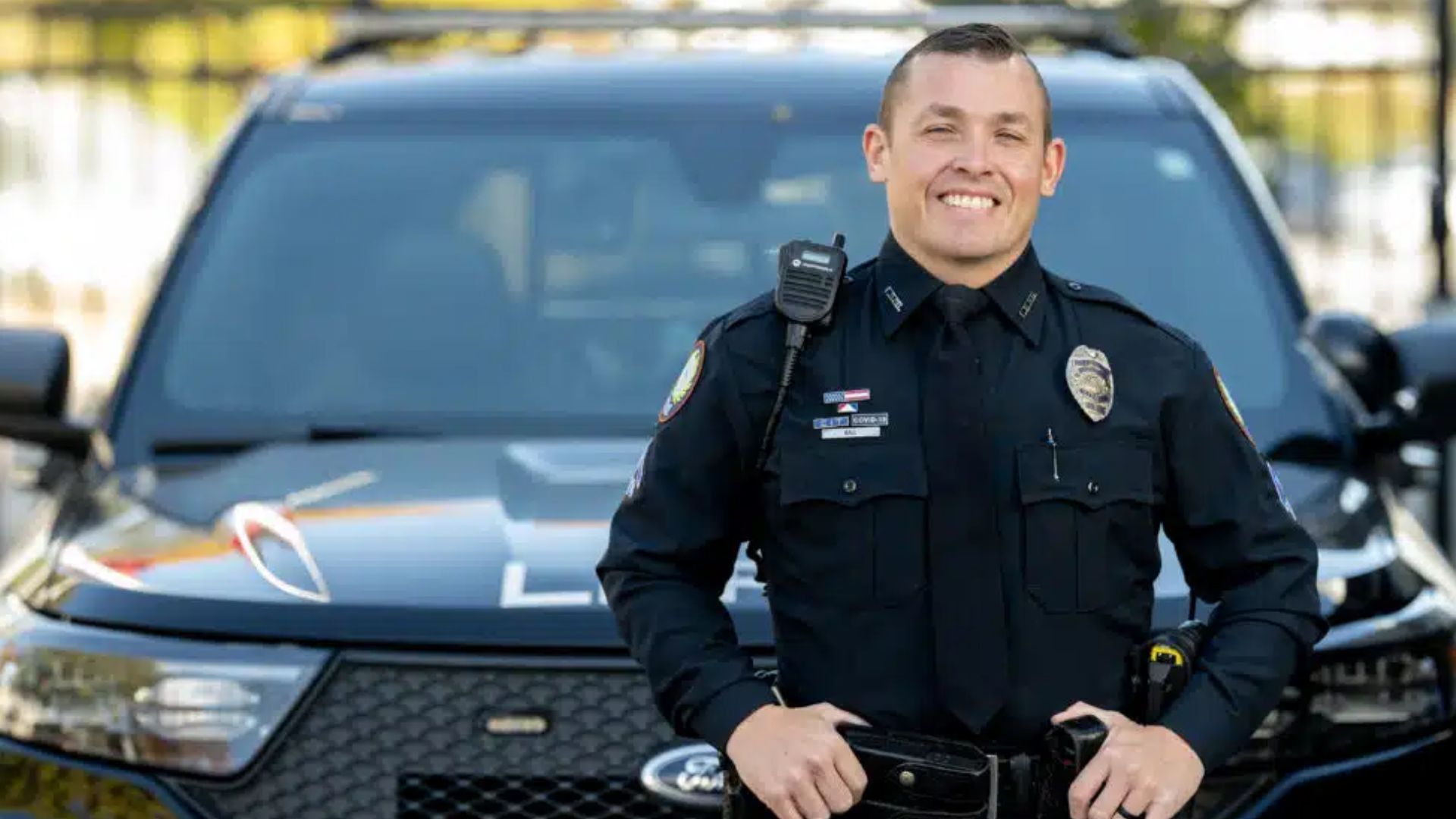
Little Rock, Arkansas – In the quiet hours of the night, when most of Little Rock is asleep, patrol officer Cody Hall begins another shift that rarely looks the same twice. Streets that feel calm in the daytime take on a different character after midnight, and Hall has spent more than a decade navigating them with a steady routine built on vigilance, repetition, and service.
This month, his work has taken on a new layer of recognition. Hall has been named the May feature in the “Faces of Arkansas” series, an initiative launched by Sarah Huckabee Sanders to highlight residents whose lives reflect the everyday reality of public service in the state. His portrait and story now appear inside the Governor’s office at the Arkansas Capitol, part of a rotating display meant to keep attention focused on the people the government serves.
The “Faces of Arkansas” series is designed as a monthly spotlight. Each installment features an Arkansan whose life story represents service, resilience, or community impact. Some are people who keep essential systems running quietly in the background, while others have overcome major personal challenges or contributed to their industries in meaningful ways.
Hall’s selection fits squarely within that vision. As a patrol officer with the Little Rock Police Department, he works the midnight shift out of the Southwest Division. His job is simple to describe but complex in practice: move through neighborhoods, monitor activity, respond to emergencies, and be present in places where help may be needed at any moment.
He has been doing this for 14 years.
“I never wanted to rank up,” Hall said. “I just wanted to stay on patrol.”
That mindset has shaped the way he approaches law enforcement. While many officers move into administrative or leadership positions over time, Hall chose to remain on the street, where he believes his presence matters most. For him, policing is not about distance or titles. It is about contact — conversations, visibility, and consistency in the same communities night after night.
Each shift begins with briefings, updates from supervisors, and a review of what might lie ahead. Then Hall steps into his patrol vehicle and moves through assigned sectors, covering main roads and quiet residential streets alike. He watches for anything unusual, but just as importantly, he represents a familiar presence in the dark.
“That visibility matters,” Hall said. “People know someone is out there watching over their neighborhood so they can sleep at night.”
That sense of responsibility is rooted in his early life. Growing up in an environment marked by violence, addiction, and instability, Hall witnessed how quickly daily life can be disrupted when safety disappears. But he also remembers moments when law enforcement made a positive difference — especially one encounter that stayed with him for years.
He recalls a police officer arriving at his home when he was young, an experience that reshaped how he saw the profession.
“It was like a superhero showing up,” Hall said. “I always told myself I’m going to be that guy.”
Today, he is.
Over the years, Hall has responded to a wide range of calls, including domestic violence incidents and serious crimes. He says every shift carries uncertainty, and no two situations unfold the same way. The job requires quick judgment, calm communication, and trust between officers working side by side.
But Hall emphasizes that the most meaningful moments often happen far from the urgency of emergency calls.
One recent encounter stands out. He met a man who was struggling emotionally and feeling overwhelmed. Instead of treating the situation as routine, Hall chose to stop and listen.
“At the end, he told me he’d never had a positive interaction with an officer before,” Hall said. “He just needed somebody to talk to.”
For Hall, that conversation mattered as much as any major incident response. He believes small moments like that are where real impact happens — not through force or authority, but through patience and presence.
Outside of work, Hall is a father of three. That role, he says, has changed how he views every shift. Policing is no longer just a job or career path. It is tied directly to the kind of community his children will grow up in.
Each night on patrol becomes a way to contribute to that future.
His work also aligns with broader public safety efforts in Arkansas, including the Protect Act signed into law in April 2023. The legislation focuses on strengthening law enforcement tools, increasing penalties for violent offenses, and addressing repeat criminal activity. State leaders have described it as part of a larger effort to improve safety outcomes across communities.
While Hall acknowledges the policy side of policing, he returns often to something simpler: trust. He says public safety depends not just on laws or procedures, but on relationships built over time between officers and the people they serve.
In Little Rock, those relationships are often quiet. A wave from a porch. A familiar car passing through a neighborhood. A brief conversation during a stop that lasts only a few minutes but leaves an impression.
For Hall, staying in the same city throughout his career has been intentional. Leaving would feel, in his words, like leaving home.
“It’s an honor to be a Face of Arkansas,” Hall said. “Especially for law enforcement. I want people to know there is positivity in this profession. We’re here to help, protect, and serve.”
As part of the “Faces of Arkansas” series, his portrait now hangs among others who reflect the state’s diverse communities and professions. The goal, according to the initiative, is not only recognition but reminder — that behind every system, service, and institution are individuals whose work shapes daily life in ways that are often unseen.
And long after the official announcements fade, Hall will likely still be on the road in the early hours of the morning, moving through quiet streets, watching over a city that sleeps while he works.


