
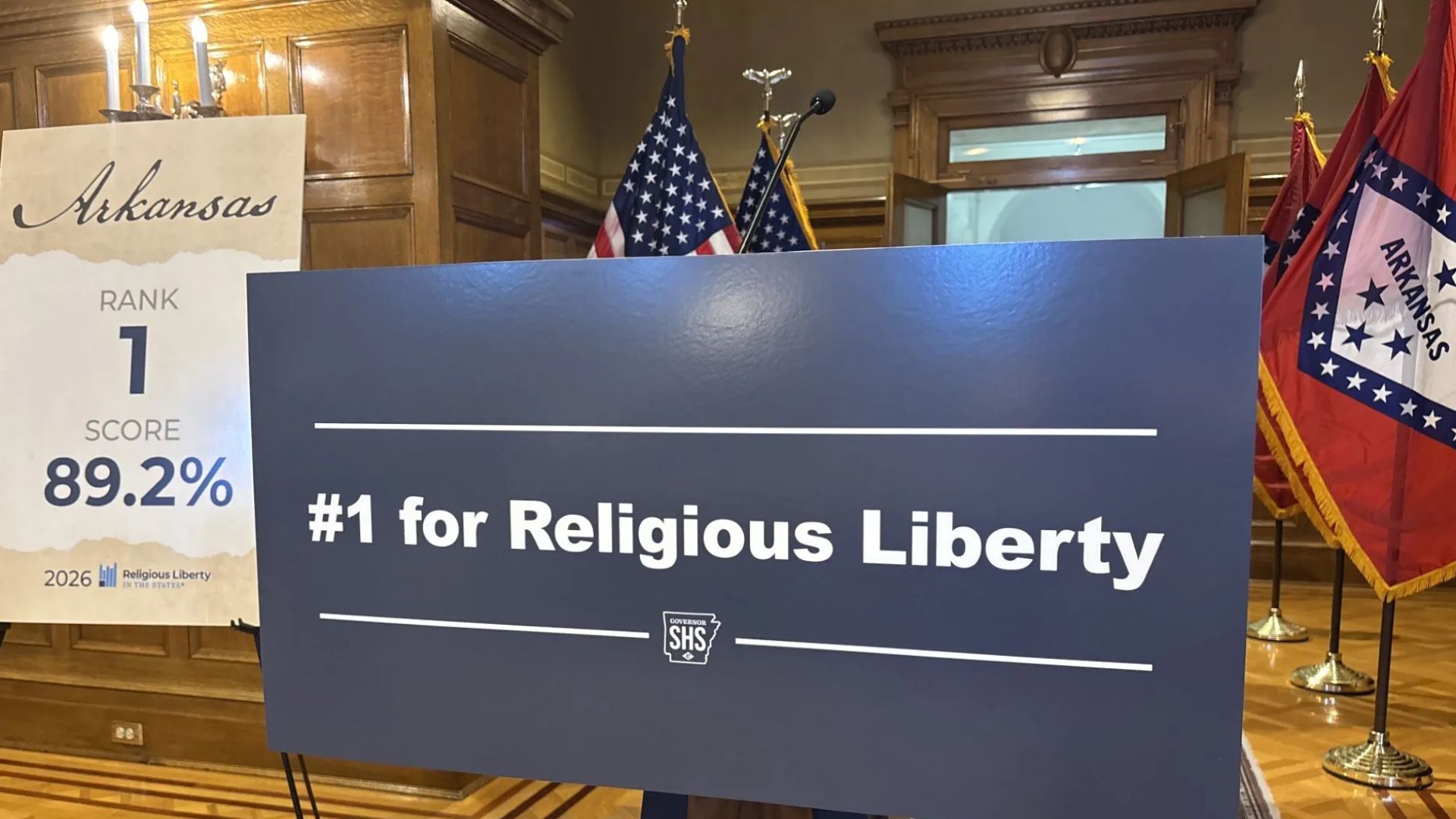
Little Rock, Arkansas – Arkansas has been ranked the top state in the nation for religious liberty, according to a new report from the First Liberty Institute’s Center for Religion, Culture & Democracy (CRCD). Governor Sarah Huckabee Sanders announced that Arkansas received the highest score in the 2026 Religious Liberty in the States (RLS) index, earning an 89.2% rating and becoming one of only two states to receive the report’s first-ever “excellent” designation.
The ranking evaluates how states protect religious freedom through laws and policies affecting daily life, including areas such as education, healthcare, family law, economic activity, and religious expression. The index examines 50 legal protections across 20 different safeguards that states can adopt to support the ability of individuals and organizations to practice their faith according to their beliefs.
Governor Sanders said the recognition reflects Arkansas’ efforts to protect religious rights and personal conscience.
“Religious liberty is America’s First Freedom, and Arkansas is leading the nation in protecting it,” said Governor Sanders. “Our rights come from God, not government, and every American should be free to live according to their faith and conscience. We’ll continue defending that freedom and ensuring the Natural State remains the best place in the country to live, work, and worship.”
According to the report, Arkansas improved significantly from its previous position. The state moved from sixth place in 2025 to the number one ranking in 2026 after lawmakers approved several measures focused on strengthening religious liberty protections.
One of the major developments highlighted in the report was Governor Sanders’ signing of Act 677. The law expanded protections for individuals and organizations that hold religious or personal beliefs related to biological sex and marriage. Supporters said the measure was designed to protect people from being penalized for expressing those views.
The state’s ranking also reflects previous actions taken by the governor. In 2023, Sanders signed the Conscience Protection Act, which strengthened existing protections under Arkansas’ Religious Freedom Restoration Act. The law aims to ensure that residents can continue to live and work according to their faith without facing government restrictions.
Kelly Shackelford, President, CEO, and Chief Counsel at First Liberty, said Arkansas’ position at the top of the index reflects decisions made by state leaders to establish stronger protections.
“Religious liberty is best protected when leaders are willing to act before the rights of people of faith are threatened,” said Kelly Shackelford, President, CEO, and Chief Counsel at First Liberty. “Governor Sanders and Arkansas lawmakers have taken that responsibility seriously, adopting strong protections that help ensure Arkansans can live and work according to conscience. Arkansas’ top ranking is a well-earned recognition, and it should motivate leaders across the country to strengthen religious liberty protections in their own states.”
Researchers involved with the index said the results show how state governments can influence religious freedom protections through legislation and policy decisions. Dr. Mark David Hall, director of the Religious Liberty in the States project, said states play an important role in shaping protections for individual rights.
“States have always served as laboratories of liberty, and this year’s results show why that matters,” said Dr. Mark David Hall, director of the Religious Liberty in the States project. “Arkansas’s rise to the top of the index demonstrates that state lawmakers can take concrete action to protect what America’s founders called ‘the sacred right of conscience.’ These safeguards help ensure that Americans are free to live out their faith in public life, not only within the walls of a house of worship.”
The report also noted that rankings can change as states introduce new laws or modify existing protections. Dr. Paul D. Mueller, Associate Director of the Religious Liberty in the States project, said the movement of states within the rankings shows that the index is designed to measure ongoing developments.
“This year’s changes show that the Religious Liberty in the States index is dynamic by design,” said Dr. Paul D. Mueller, Associate Director of the Religious Liberty in the States project. “Arkansas moved from sixth to first, and Tennessee moved from tenth to second, because both states adopted meaningful protections for religious liberty. With this index, citizens and legislators can see where their state is doing well, where it still has room to improve, and which existing laws could help them better protect the right of conscience.”
In addition to legislative actions, Governor Sanders also drew attention to her decision to keep state offices closed in recognition of Christmas. The move came after some activists called for the proclamation to be withdrawn. Sanders defended the decision, saying that recognizing religious traditions helps communities feel respected and included.
The governor said Arkansas will continue working to maintain its position as a state that protects religious expression and individual beliefs. Supporters of the ranking argue that the state’s policies provide residents with greater freedom to practice their faith in everyday life, while critics of some religious liberty laws continue to debate their impact on other rights and protections.
With its first-place ranking in the Religious Liberty in the States index, Arkansas has become a leading example in the national discussion over the role of state governments in protecting religious freedom and personal conscience.


